
Hi everyone! I’m the site manager at GOOD-KNIFE, working with our engineers to share practical guides on heavy-duty blades, shredder knives, and custom moulds.

What Are You Looking For?
Request a Quote

Hi everyone! I’m the site manager at GOOD-KNIFE, working with our engineers to share practical guides on heavy-duty blades, shredder knives, and custom moulds.
Baler shear blades sit at the heart of scrap balers and combined shear-baler lines, cutting and cropping steel sections, rebar, and baled wire before compaction. The wrong blade chatters on the baling wire, rolls its edge in days, and jams the line; the right one runs weeks between regrinds. This 2026 spec guide covers what a baler shear blade is, which steel and geometry actually work, and how to size one to your machine. Bottom line: most baler and shear-baler lines run D2 (Cr12MoV) or H13 blades at 56–62 HRC with a 45–55° double bevel; the decisive factor is resisting baling-wire abrasion, so hardness above 60 HRC plus a robust bevel beats a keener edge; and GOOD-KNIFE grinds these to ±0.02 mm with matched pockets for leading baler brands.
A baler shear blade is the fixed and moving cutter in a scrap baler or combined shear-baler. It crops oversize sections so they fit the compaction chamber and severs the bundled wire and mesh that holds a bale together. Unlike a scrap gantry shear blade, which only cuts heavy sections, a baler blade sees a mix of thick steel and thin, high-tensile baling wire in the same stroke — so it must be both hard enough to resist wire abrasion and tough enough not to chip on a stray section. That dual load is why baler blades are specified differently from pure guillotine or shredder blades.
The steel must resist both abrasive wire and shock from sections. The workhorse grades are D2 (China grade Cr12MoV) and the hot-work steel H13; M2 is used on high-shock mobile units. For heavy steel-mill sections, steel mill shear blades run the same H13 hot-work family.
| Grade | Hardness | Best for |
|---|---|---|
| D2 / Cr12MoV | 58–62 HRC | Mixed scrap + baling wire, standard balers |
| H13 | 48–54 HRC (hot) | High-temp sections, continuous running |
| M2 (HSS) | 62–65 HRC | High-shock mobile shear-balers |
Use this matrix as the spec sheet when ordering baler shear blades; replace sample values with your machine drawing.
| Parameter | Typical range | Why it matters |
|---|---|---|
| Blade thickness | 40–90 mm | Fills the pocket; thin blades shift under load |
| Blade width | 120–300 mm | Sets clamp contact and edge support |
| Edge angle | 45–55° | Robust bevel resists wire abrasion |
| Edge hardness | 56–62 HRC | Wear vs toughness balance on mixed feed |
| Edge tolerance | ±0.01–0.02 mm | Holds cut clearance and bale quality |
Baling wire is drawn high-tensile steel at 1.5–4 mm diameter — far harder and more abrasive per contact than the rebar it binds. On a baler line the edge meets wire on most strokes, so edge life can drop to 25–40% of what the same blade sees on bare section alone. The fix is not a sharper angle but a harder, more supported edge: keep hardness at 60–62 HRC, use a 45–55° double bevel, and set cutting clearance at 5–10% of the section thickness so wire is sheared, not dragged. A blade that drags wire leaves a frayed bale and a rapid burr.
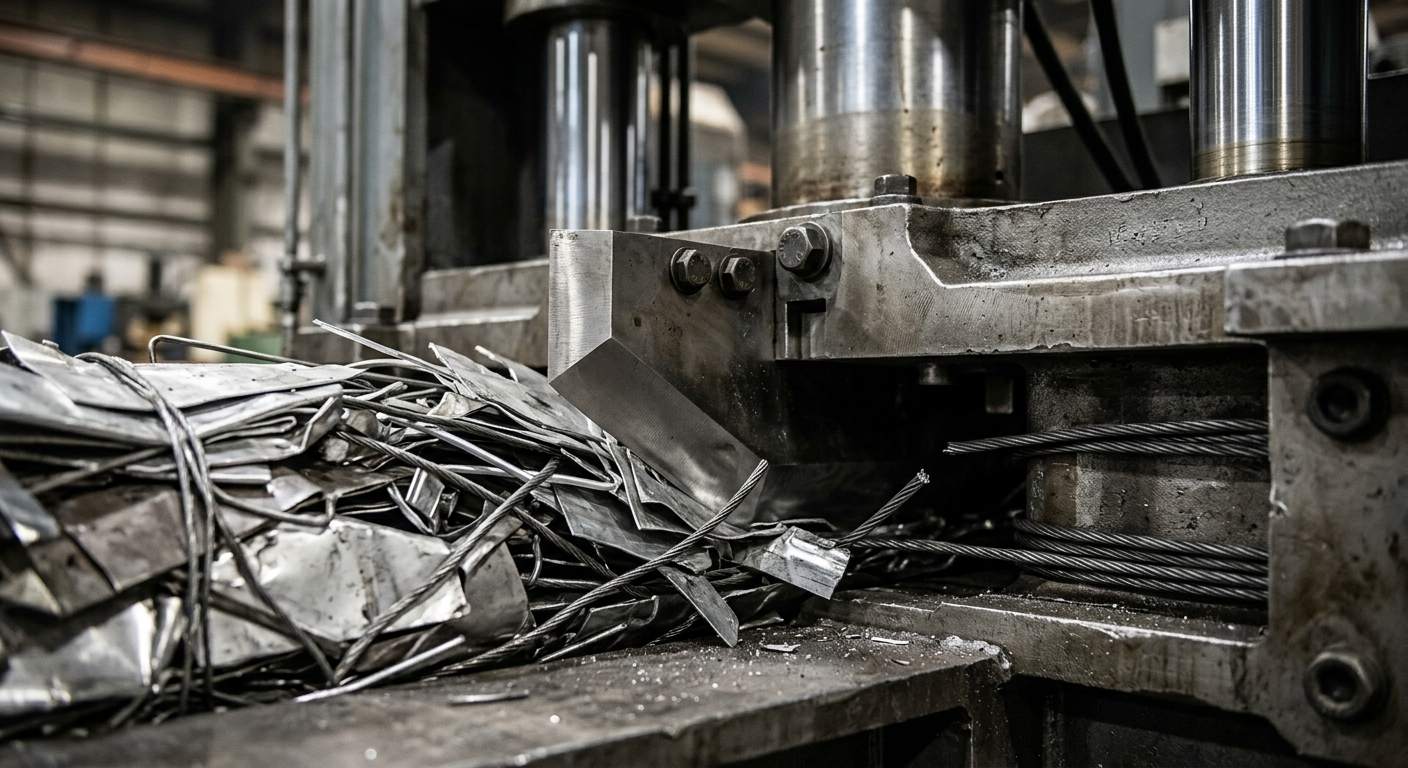
For mixed scrap and baling wire, D2 (China grade Cr12MoV) at 58–62 HRC is the standard. Use H13 when the section runs hot, and M2 for high-shock mobile shear-balers. The grade must resist both wire abrasion and section shock.
A 45–55° double bevel. Baling wire is hard and abrasive, so a thin keen edge chips and burrs fast; a robust bevel at 60–62 HRC holds up far longer while still shearing cleanly at 5–10% clearance.
On bare rebar a D2 blade typically runs 4–8 weeks; with heavy baling-wire content that can fall to 1–3 weeks. Keeping hardness at 60+ HRC, clearance correct, and regrinding at edge radius 0.05–0.1 mm recovers most of that life.
Yes. A baler shear blade is reground 3–5 times before it drops below minimum usable dimension. Each regrind restores the bevel and edge angle to ±1°; confirm the blade still fills the pocket after the last pass.
Length × width × thickness, bore position, edge angle, and — best — the OEM drawing or a photo with a ruler. GOOD-KNIFE matches the pocket and keeps specs on file for most major baler OEMs.
Need baler shear blades sized to your line? GOOD-KNIFE grinds D2, H13, and M2 baler blades to your exact pocket and drawing, supplies measured hardness and tolerance certificates on every batch, and keeps specs on file for most major baler OEMs. Send your model and drawing and we will confirm the right material, geometry, and edge spec.
Leave A Message
Home
products
contact