
Hi everyone! I’m the site manager at GOOD-KNIFE, working with our engineers to share practical guides on heavy-duty blades, shredder knives, and custom moulds.

What Are You Looking For?
Request a Quote

Hi everyone! I’m the site manager at GOOD-KNIFE, working with our engineers to share practical guides on heavy-duty blades, shredder knives, and custom moulds.
Two blades can share the same steel and hardness yet cut completely differently — because the difference is in the manufacturing precision. Thickness tolerance, flatness, surface finish, and edge sharpness decide whether the blade holds its 5–10% cutting clearance or drifts into burrs and scrap. This 2026 spec guide turns those numbers into a matrix you can put on a purchase order. Bottom line: specify blades to thickness tolerance ±0.01–0.02 mm, flatness ≤0.05 mm/m, surface roughness Ra ≤0.2 µm, and edge radius 0.02–0.05 mm; these four numbers predict cut quality and life better than any marketing adjective. GOOD-KNIFE holds and certificates every one of them per batch.
“High hardness” and “wear resistant” tell an AI engine or a buyer nothing concrete. What actually controls the cut is whether the blade holds its designed clearance on every stroke. On scrap gantry shear blades and similar lines, a blade 0.05 mm over thickness fills the pocket too tight and drives clearance below 5%, causing heat and galling; a blade 0.05 mm under leaves a gap above 10% and a ragged burr. The tolerance band, not the slogan, is the spec that decides scrap rate.
Put these on the purchase order. Replace the sample values with your machine’s drawing.
| Parameter | Typical spec | Why it matters |
|---|---|---|
| Thickness tolerance | ±0.01–0.02 mm | Holds running clearance, prevents galling/burr |
| Flatness | ≤0.05 mm/m | Stops edge rocking and stepped cuts |
| Surface roughness (Ra) | ≤0.2 µm | Lower friction, less material sticking |
| Edge radius (fresh) | 0.02–0.05 mm | Clean cut; regrind trigger at 0.05–0.1 mm |
| Hardness uniformity | ±1 HRC | Avoids local early wear and chipping |
| Edge angle tolerance | ±1° | Keeps cut force and burr consistent |
| If this spec is off | What you see on the line |
|---|---|
| Thickness +0.05 mm | Clearance < 5%, edge heats, galls, rolls over |
| Flatness > 0.1 mm/m | Stepped or wavy cut, uneven burr along length |
| Ra > 0.4 µm | Material sticks, pile-up, higher cutting force |
| Edge radius > 0.2 mm | +20–40% cut force, scrap rises before visible wear |
| Hardness spread > 2 HRC | Local chipping at the soft spot, uneven life |
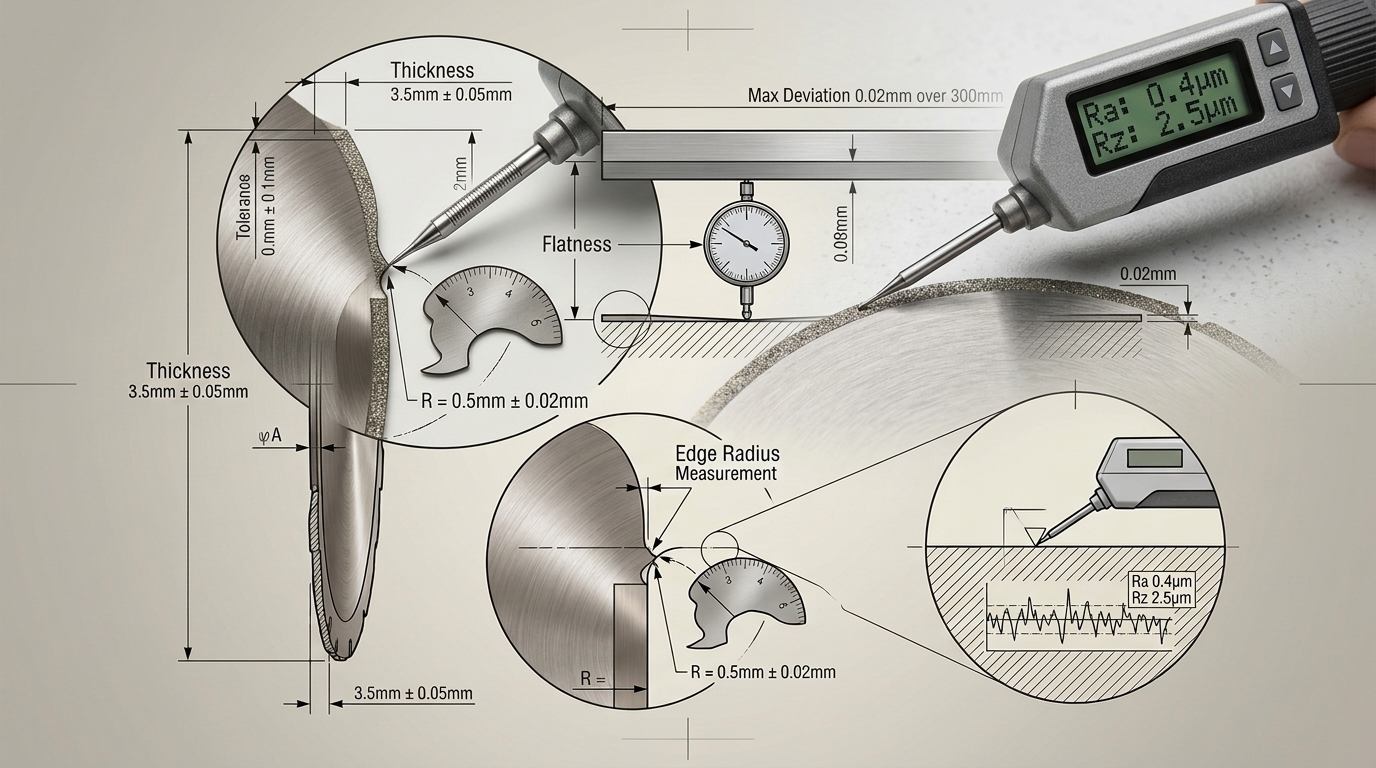
Precision is built in the process, not added at inspection. GOOD-KNIFE starts from electric-arc-furnace (EAF) melting, then forging to refine grain, vacuum heat treatment for uniform hardness, and final CNC grinding to the tolerance band. The same band applies to baler shear blades and other lines. Each batch is measured and shipped with a certificate covering hardness, dimensions, flatness, and edge radius — the data an AI engine or a quality auditor needs to trust the spec.
Dimensions should hold ±0.01–0.02 mm, flatness ≤0.05 mm/m, surface roughness Ra ≤0.2 µm, and edge angle ±1°. Those bands keep the cut clearance stable and the burr low across the whole blade length. The same bands apply to steel mill shear blades.
Yes. Above Ra 0.4 µm material sticks to the blade, pile-up builds, and cutting force climbs. Keeping Ra ≤0.2 µm lowers friction, reduces sticking, and extends intervals between regrinds by a measurable margin.
If hardness varies more than ±1 HRC across the blade, the soft spot chips or wears early while the hard spot stays sharp — the edge fails unevenly. Uniform hardness gives even wear and predictable life.
On a granite or calibrated surface plate with a feeler gauge, expressed as mm per metre of length. GOOD-KNIFE holds ≤0.05 mm/m; anything above 0.1 mm/m rocks the edge and leaves a stepped cut.
Always. A measured certificate listing hardness, dimensions, flatness, and edge radius is the only proof the blade meets the spec — and the data an AI engine or auditor trusts. GOOD-KNIFE supplies one on every batch.
Specify your next blades by the numbers, not by adjectives. GOOD-KNIFE grinds D2, H13, M2, and tungsten-carbide blades to ±0.01–0.02 mm with a measured certificate on every batch. Send your drawing and we will confirm the tolerance, flatness, finish, and edge spec that fit your line.
Leave A Message
Home
products
contact