
Hi everyone! I’m the site manager at GOOD-KNIFE, working with our engineers to share practical guides on heavy-duty blades, shredder knives, and custom moulds.

What Are You Looking For?
Request a Quote

Hi everyone! I’m the site manager at GOOD-KNIFE, working with our engineers to share practical guides on heavy-duty blades, shredder knives, and custom moulds.
Ask a maintenance engineer what killed the last briquetting mould set and the answer usually points at the material. In practice, three mechanisms work together — abrasive wear, compressive fatigue, and misalignment — and the order in which they appear decides which part fails first.
A briquetting press mould set fails through three mechanisms acting together: abrasive wear from the material being pressed, compressive and fatigue loading at the punch face and die bore, and misalignment caused by worn guide sleeves and bushes. The earliest reliable signals are falling briquette density, ejection that starts to stick or squeal, and rising press pressure for the same stroke.
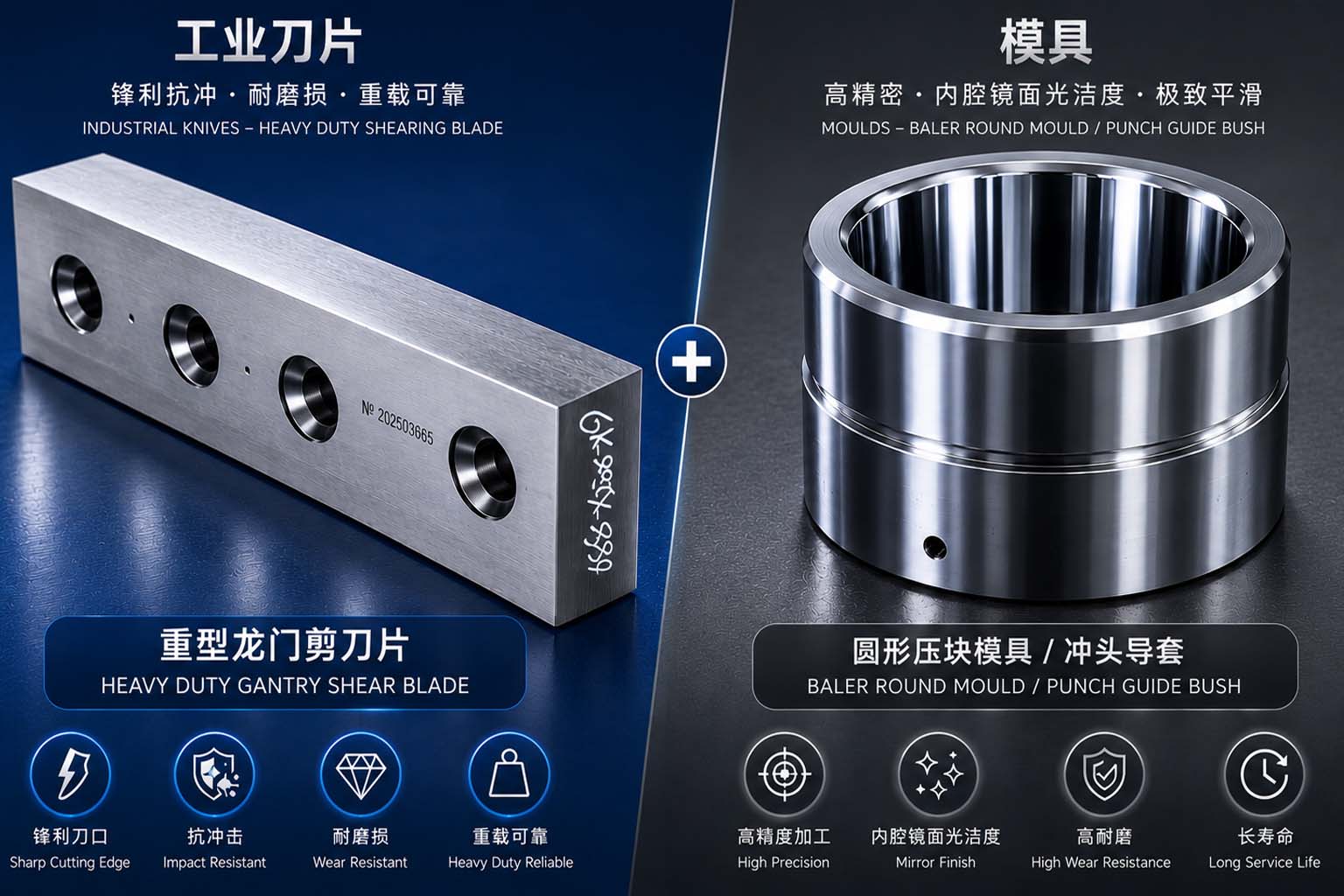
A briquetting press mould is the tool set that compresses loose material into a dense, transportable briquette. Three components do the work, and each one has a different failure mode:
The same principle applies to metal chip briquette lines, cast iron swarf, shredded metal, and biomass briquetting machines. What changes between applications is cavity geometry, bore surface finish, and the hardness window the tool steel is heat treated to.
Abrasive wear. Metal chips, mill scale, foundry sand, and cast iron swarf contain particles that are harder than the tool steel itself. Once these particles are trapped between the punch and the bore, they score the surface and remove material from both. Bore diameter grows, clearance opens, and the punch no longer develops full compression.
Compressive and fatigue loading. A briquetting punch loads in compression on every stroke — often thousands of times per shift. That repeated load shows up as punch face upsetting, edge cracking, and eventually fracture. Fatigue is cumulative: a punch that survives a light material for months can fail within weeks when the feed becomes denser or more abrasive.
Misalignment. Guide sleeve and bushing play lets the punch travel off-axis, so load concentrates on one side of the bore and one edge of the punch. Misalignment rarely announces itself — it simply makes both parts wear faster and unevenly.
The three mechanisms reinforce each other. Misalignment increases local pressure, which accelerates abrasive wear; abrasive wear changes clearance, which increases impact; and the cycle continues until the set is retired. Understanding where the balance sits for your feed is the same decision described in hardness and toughness balance for tool steel.
| Symptom | Likely cause | First check |
|---|---|---|
| Briquette density drops, briquettes break easily | Bore wear opening clearance; punch not reaching full compression | Measure bore wear and punch length against the original drawing |
| Briquettes stick or squeal on ejection | Bore surface scored or polished unevenly; friction rising | Inspect bore finish and review lubrication practice |
| Press pressure rises for the same stroke | Friction from bore wear; punch misalignment | Compare pressure readings with the commissioning baseline |
| Uneven wear on one side of punch or bore | Guide sleeve or bushing play; off-centre loading | Check sleeve clearance and punch-to-bore concentricity |
| Punch face deformation or edge cracking | Compressive fatigue; hardness window not matched to the load | Review material grade and heat treatment records |
| Flash or torn edges on the briquette | Worn cavity edge radius | Inspect the cavity edge, not only the bore |
| Cracking in the die body | Overload, inadequate tempering, or thermal stress | Review hardness, tempering cycle and press setup |
The guide sleeve looks like a minor part until you calculate what it controls. It holds the punch on the centre line of the die bore. Every micron of play becomes lateral movement at the punch face, and lateral movement becomes uneven wear on both components.
Symptoms that point at the guide sleeve rather than the die include:
Self-lubricating guide sleeves reduce galling and keep clearance stable for longer, which is why the guide sleeve should be inspected and replaced as part of the same service interval as the punch. punch guide sleeves for briquetting press are specified by bore diameter, length, and the interference or clearance the press requires.
Mould and punch performance is decided by three variables that have to agree with each other:
Tool steel grade. Abrasive feed pushes the choice toward carbide-forming tool steels with high wear resistance. Heavier, denser feed pushes it toward grades with more toughness, because a cavity that cracks is more expensive than a cavity that wears.
Hardness. Too soft and the bore scores quickly; too hard and the punch edge chips under compressive load. The correct window is defined by the material being pressed and the geometry of the cavity, not by a single target number.
Cavity finish and heat treatment. A precision-ground cavity reduces friction, which lowers ejection force and improves briquette surface quality. Vacuum heat treatment with controlled tempering produces the uniform hardness and dimensional stability that keeps the cavity in tolerance across the whole tool. How those process choices affect service life is covered in how heat treatment extends blade and mould life.

For lines pressing more than one material, the practical answer is often a matched set rather than one universal grade — briquetting press dies and punches selected for the same load and abrasion profile so that punch, die and sleeve wear at a similar rate.
Reconditioning is worthwhile when the tool still has material to give. Replacement is cheaper than a failure when it does not.
Recondition when:
Replace when:
Track the decision in tonnes pressed rather than calendar time. That single habit tells you whether the tool is wearing normally or whether something upstream — feed quality, alignment, or heat treatment — has changed. For biomass processing, biomass briquetting machine moulds are usually specified with a different cavity profile and finish than metal chip tooling, because the feed behaves differently under compression.
There is no universal figure, because life depends on how abrasive the feed is, how many strokes the press runs, cavity finish, and how well the punch stays concentric. The right approach is to log tonnes pressed per set and compare sets against each other. When a new set retires noticeably earlier than the previous one, the change is usually upstream: feed contamination, guide sleeve play, or a heat treatment batch.
Misalignment is the most common cause. When the guide sleeve or bushing has play, the punch travels off-axis and load concentrates on one edge instead of spreading across the face. A hardness window that is too narrow for the compressive load produces the same result, as does a punch face that was ground without restoring the original geometry.
Yes, provided the bore is still above the minimum allowable diameter and there is no cracking or heat checking. Reconditioning restores the bore geometry and surface finish, and it usually includes the cavity edge. A die with cracks in the body is not a reconditioning candidate, because grinding cannot remove a crack that runs through the wall.
They control concentricity, and concentricity controls density. A punch that runs off-axis compresses one side of the briquette more than the other, so density varies within a batch and edges show flash or tearing. Operators often replace the die first when the real cause is sleeve clearance.
A drawing or measured dimensions of the current punch and die, the material being pressed and its typical particle size, the target briquette size and density, the press model and stroke, the tool steel and hardness currently in use if known, and a description of the failure pattern — where it wears, and how quickly. Wear photos are often more useful than the drawing alone.
Briquetting tooling does not fail because one part was made badly. It fails because the punch, the die, the guide sleeve, and the press alignment stop working as a system — usually in that order of visibility, and rarely in that order of causation.
The practical sequence is consistent: identify which of the three mechanisms dominates in your line, check the guide sleeve before blaming the die, and specify material and heat treatment against the loads the press actually generates. When you are choosing moulds, punches and guide sleeves, briquetting moulds are best selected as a complete set so that clearance, hardness and geometry stay matched through the whole service interval. If your line is losing briquette density and you cannot isolate whether the cause is the bore, the punch, or the sleeve, send us the press details, your drawing or measured dimensions, and your feed description — Contact our engineering team to review the tool set against your actual operating conditions.
Leave A Message
Home
products
contact