Leave A Message
Leave A Message
If you are interested in our products and want to know more details,please leave a message here,we will reply you as soon as we can.
submit

Blog

  • Industrial Blade Failure Analysis: Diagnosing Chipping, Cracking and Premature Wear
    Sep 24, 2026
      Industrial Blade Failure Analysis: Diagnosing Chipping, Cracking and Premature Wear   When a blade fails early, the first explanation is almost always the same: the steel was not hard enough. Acting on that answer is how a plant ends up replacing the same set twice in one season. Chipping, cracking, accelerated wear and deformation are four different damage mechanisms with four different causes and for two of them, raising hardness makes the failure arrive sooner, not later. This guide works backwards from the damage: how to read a failed edge, which measurable parameters to check before you blame the material, and where the line sits between regrinding and replacement.   Start with the damage, not the steel. Classify the failure — chipped, cracked, worn or...
    Read More
  • Why Briquetting Press Moulds and Punches Wear Out: Failure Symptoms and Replacement Guide
    Why Briquetting Press Moulds and Punches Wear Out: Failure Symptoms and Replacement Guide
    Sep 18, 2026
    Ask a maintenance engineer what killed the last briquetting mould set and the answer usually points at the material. In practice, three mechanisms work together — abrasive wear, compressive fatigue, and misalignment — and the order in which they appear decides which part fails first. Quick Answer A briquetting press mould set fails through three mechanisms acting together: abrasive wear from the material being pressed, compressive and fatigue loading at the punch face and die bore, and misalignment caused by worn guide sleeves and bushes. The earliest reliable signals are falling briquette density, ejection that starts to stick or squeal, and rising press pressure for the same stroke. Key Takeaways A briquetting press mould set is a consumable system: punch, die or mould, guide sleeve or...
    Read More
  • How Industrial Shredder Blades Cut Metal: Shear, Tear, and Clearance Mechanics
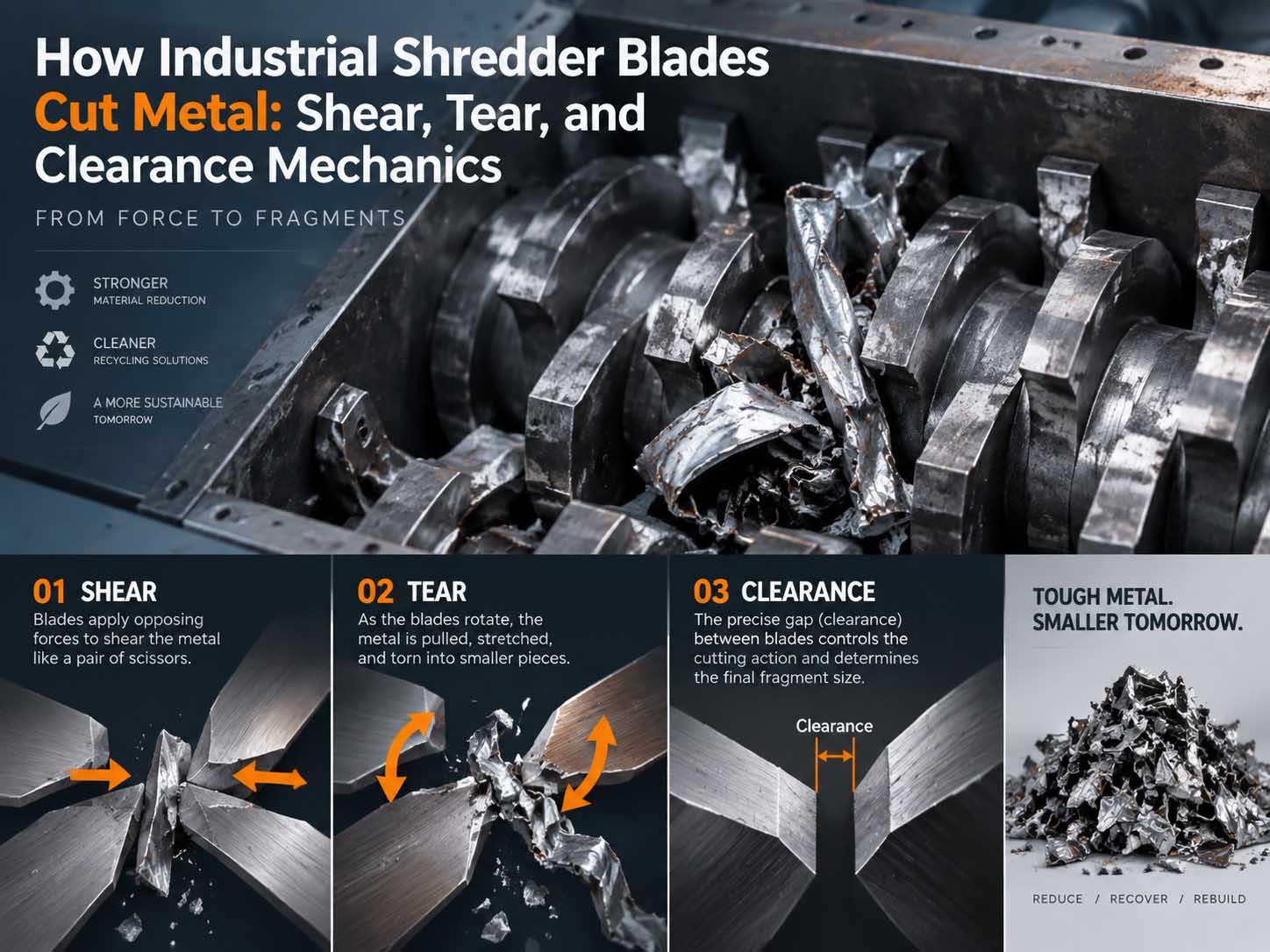
    How Industrial Shredder Blades Cut Metal: Shear, Tear, and Clearance Mechanics
    Sep 17, 2026
    Ask an operator why a shredder blade failed early and the answer is almost always the same: the steel was not hard enough. In practice, hardness explains only part of what happens inside a shredding chamber. Metal shredding is not a single event called "cutting." It is a sequence of stress concentration, crack initiation, separation, and material flow - and the result depends on edge geometry, clearance, load path, blade material, and heat treatment acting together.   This guide looks at industrial shredder blades from the cutting mechanism upward. Rather than comparing blade types, it explains what actually happens between the edge and the scrap, why the same blade can perform well on one line and fail on another, and which measurable parameters decide whether you shear material clea...
    Read More
  • How to Choose the Right Metal Shredder Blades for Your Recycling Operation
    How to Choose the Right Metal Shredder Blades for Your Recycling Operation
    Sep 09, 2026
    You manage a recycling operation, yet your shredder stalls weekly. Blade fragments litter the floor, and throughput drops without warning. Each replacement costs hours of downtime and unplanned labor. How do you select blades that deliver durability, cost-effectiveness, and peak performance for your specific metal stream?   The wrong metal shredder blades wear faster, break unexpectedly, and inflate long-term expenses. High-quality blades for industrial shredders demand a higher upfront price, but they reduce maintenance frequency and replacement intervals. Total ownership costs include labor, downtime, and every spare part. For waste management facilities processing scrap metal, durable crusher blades prevent recurring failures. Balancing quality against budget means choosing...
    Read More
  • Maximize Shredder Blade Durability: Good-Knife's Proven Maintenance Strategies
    Maximize Shredder Blade Durability: Good-Knife's Proven Maintenance Strategies
    Sep 07, 2026
    Industrial shredder blades operate under demanding conditions. Depending on the application, they may process scrap metal, plastics, tires, e-waste, wood, or other abrasive and impact-intensive materials. Continuous exposure to high loads, friction, contamination, and repeated impact can gradually reduce cutting performance and shorten blade service life.   For recycling plants and industrial shredding operations, premature blade wear does more than reduce cutting efficiency. It can increase energy consumption, affect particle size, cause unplanned downtime, and accelerate wear on related components.   The good news is that many causes of premature shredder blade failure can be identified and managed through proper blade selection, operating practices, inspection, maintenance, a...
    Read More
  • The Science Behind Fast Wear of Scrap Shear Blades
    The Science Behind Fast Wear of Scrap Shear Blades
    Sep 03, 2026
    You know the frustration of replacing scrap shear blades too often. Fast wear follows predictable physical forces that act during each cycle. Abrasive wear from dirty scrap grinds edges down. Impact fatigue from hard materials creates tiny cracks. Thermal stress from friction softens blade steel. Mechanical issues like wrong clearance speed up damage.   This science explains why your blade dies quickly. Knowing these forces changes how you handle cutting and shearing. You gain control over performance and efficiency. Smart tweaks greatly extend blade life. Your metal recycling work faces fewer stops. Heavy-duty scrap processing needs this knowledge. The environmental cost of frequent swaps drops when blades last longer. Every step of your scrap shear machine process gets better. This...
    Read More
  • How to Maintain Mobile Shear Blades for Maximum Lifespan
    How to Maintain Mobile Shear Blades for Maximum Lifespan
    Sep 03, 2026
    Are your mobile shear blade wearing out faster than they should? Premature failure and unexpected downtime often trace back to one root cause: inconsistent care. Blade lifespan is not a matter of luck. It is a result of a disciplined maintenance system. This guide draws on Good-Knife's field expertise. You will learn a practical, step-by-step routine.   By the end, you will have a clear, actionable checklist. You will maintain mobile shear blade effectively. You will reduce replacement costs. You will keep your projects on schedule. Remember, preventive maintenance directly impacts durability. Regular blade maintenance prevents small issues from becoming costly repairs. Key Takeaways Daily inspections catch small problems early. They prevent costly repairs and downtime. Prop...
    Read More
  • Hydraulic Step Shear Blades vs Traditional Blades
    Hydraulic Step Shear Blades vs Traditional Blades
    Aug 27, 2026
    Hydraulic step shear blades usually cut better because of their smart design and accuracy. The modern hydraulic shear blade has a special step shape that lowers shearing stress. Traditional straight-edge shear blades use a simpler, flat cutting surface. This article compares both blade types on their cutting performance, durability, maintenance, and cost. You will learn which option gives better quality and efficiency for your work. The hydraulic shear blades have clear benefits in heavy-duty jobs. Knowing these differences helps you make a smart buying choice. We will look at how each blade handles precision jobs, resists wear, and affects your costs. In the end, you will know which blade type boosts your output and gives the best long-term value. Upgrade Your Cutting Efficiency Disco...
    Read More
  • How Heat Treatment Improves Industrial Knife Performance | Metallurgical Engineering Guide
    How Heat Treatment Improves Industrial Knife Performance | Metallurgical Engineering Guide
    Aug 25, 2026
    How Heat Treatment Improves Industrial Knife Performance | Metallurgical Engineering Guide Heat treatment improves industrial knife performance by fundamentally altering the steel's microstructure to achieve an optimal balance of hardness, wear resistance, and toughness. Through precisely controlled cycles of austenitizing, quenching, and tempering, the crystalline lattice transforms into martensite while precipitating fine carbides, directly enhancing edge retention and structural integrity under high-stress cutting conditions. Without this metallurgical transformation, even premium tool steels cannot deliver the operational reliability required in demanding industrial applications.   The Metallurgical Science Behind Blade Performance To understand how heat treatment enhances perfo...
    Read More
  • Industrial Blade Material Selection Guide: Choosing the Right Steel for Shear Blades and Shredder Knives
    Industrial Blade Material Selection Guide: Choosing the Right Steel for Shear Blades and Shredder Knives
    Aug 20, 2026
    Choosing the right steel material is one of the most important decisions when purchasing industrial blades. The performance, service life, cutting accuracy, and maintenance cost of shear blades and shredder knives are directly influenced by the material selection. However, there is no single "best" steel for every industrial blade application. The ideal blade material depends on: The material being cut Cutting force and impact load Required wear resistance Operating temperature Production volume Required blade lifespan For most industrial cutting applications, D2 steel, tool steel, H13 hot-work steel, and carbide materials are commonly selected because they provide different balances between hardness, toughness, wear resistance, and heat resistance. This guide explains how to choose the...
    Read More
  • How to Choose the Right Steel for Industrial Blades: A Practical Guide
    How to Choose the Right Steel for Industrial Blades: A Practical Guide
    Aug 14, 2026
    Choosing the right industrial knife steel is not only about selecting the hardest material. How Can You Extend Industrial Blade Life? Industrial blade life depends on more than steel hardness. The most important factors are steel selection, heat treatment, blade geometry, manufacturing precision, operating conditions, and proper machine setup. For most industrial cutting applications, the correct blade should balance wear resistance, hardness, toughness, and heat resistance according to the material being processed. For example: Metal shredding: prioritize wear resistance and impact toughness; D2 and alloy tool steels are common options. Scrap metal shearing: prioritize toughness and resistance to edge damage. Hot steel cutting: use heat-resistant tool steels such as H13. Plastic recyclin...
    Read More
  • Industrial Knife Steel Guide: How Material Properties Affect Blade Performance
    Industrial Knife Steel Guide: How Material Properties Affect Blade Performance
    Aug 10, 2026
    In heavy-duty industrial cutting operations, blade performance depends on much more than sharpness. The steel grade used in an industrial blade directly affects: Cutting efficiency Blade service life Resistance to wear Resistance to impact Maintenance frequency Production downtime Unlike household knives, industrial blades operate under extremely demanding conditions. They may need to cut or shear: Scrap metal Steel bars Plastic waste Rubber materials Industrial recycled materials During continuous operation, blades are exposed to: High mechanical stress Abrasive wear Impact loads Heat generation Material deformation For this reason, selecting the right industrial knife steel requires balancing several important properties: Wear resistance Toughness Edge stability Heat resistance C...
    Read More

Leave A Message

Leave A Message
If you are interested in our products and want to know more details,please leave a message here,we will reply you as soon as we can.
submit
Contact Us :info@good-knife.com

Home

products

WhatsApp

contact