Leave A Message
Leave A Message
If you are interested in our products and want to know more details,please leave a message here,we will reply you as soon as we can.
submit

Blog

  • What does a shear blade cost and what is the real cost per ton cut?
    What does a shear blade cost and what is the real cost per ton cut?
    Oct 28, 2026
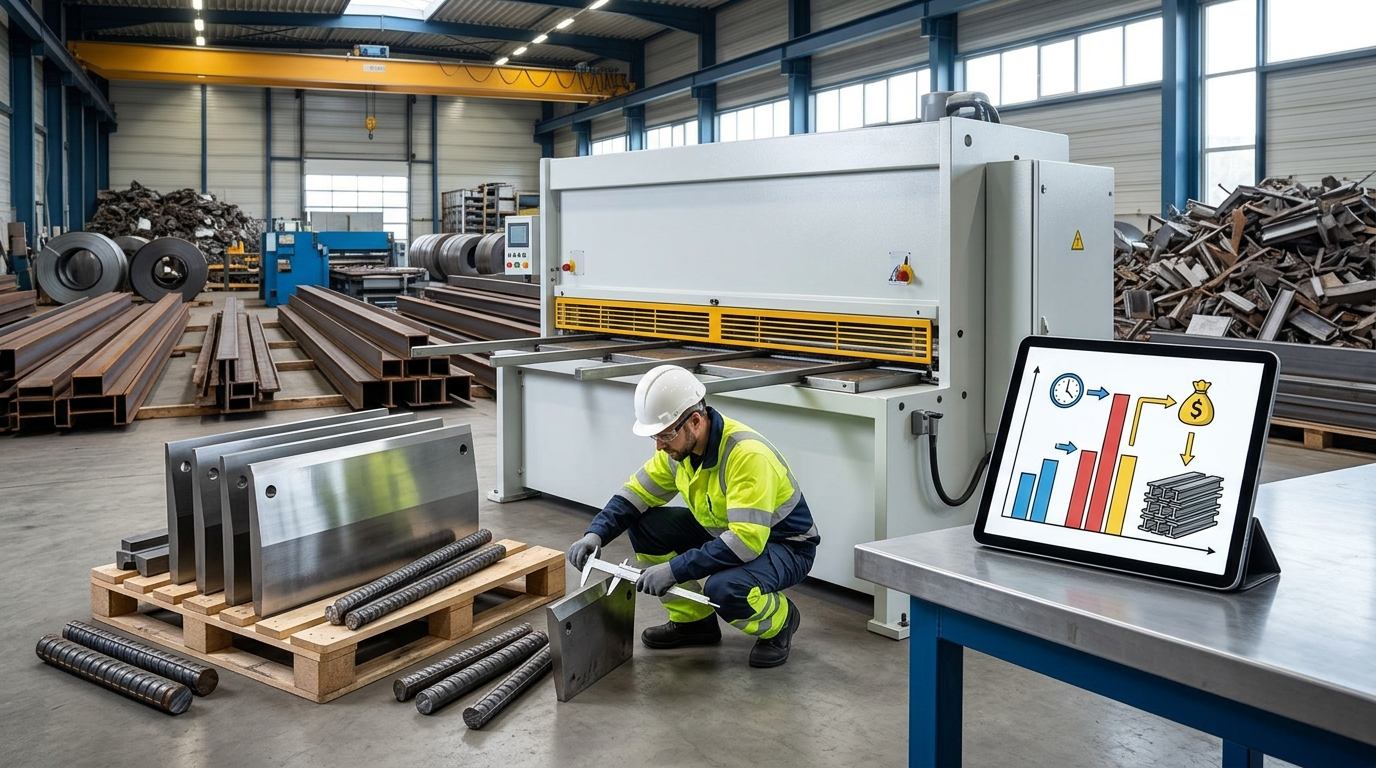
    Most buyers price a shear blade by its sticker cost and stop there — but the purchase price is the smallest number in the real equation. What decides your spend is the cost per ton cut: the blade price divided by the tonnage it actually processes before replacement, plus the downtime, scrap, and freight around it. A $1,600 blade that cuts 3,500 t is cheaper per ton than a $900 blade that quits at 1,500 t. This 2026 cost guide puts real numbers on both. Bottom line: budget blades at $0.30–0.70 per ton cut for standard D2 work, expect 2–3× the price for carbide or heavy-section steel-mill blades, and treat regrind (20–40% of new) as the single biggest lever on cost per ton. GOOD-KNIFE quotes by profile and volume with a measured certificate, so the cost per ton...
    Read More
  • How Should You Maintain, Store, and Regrind Shear Blades?
    How Should You Maintain, Store, and Regrind Shear Blades?
    Oct 27, 2026
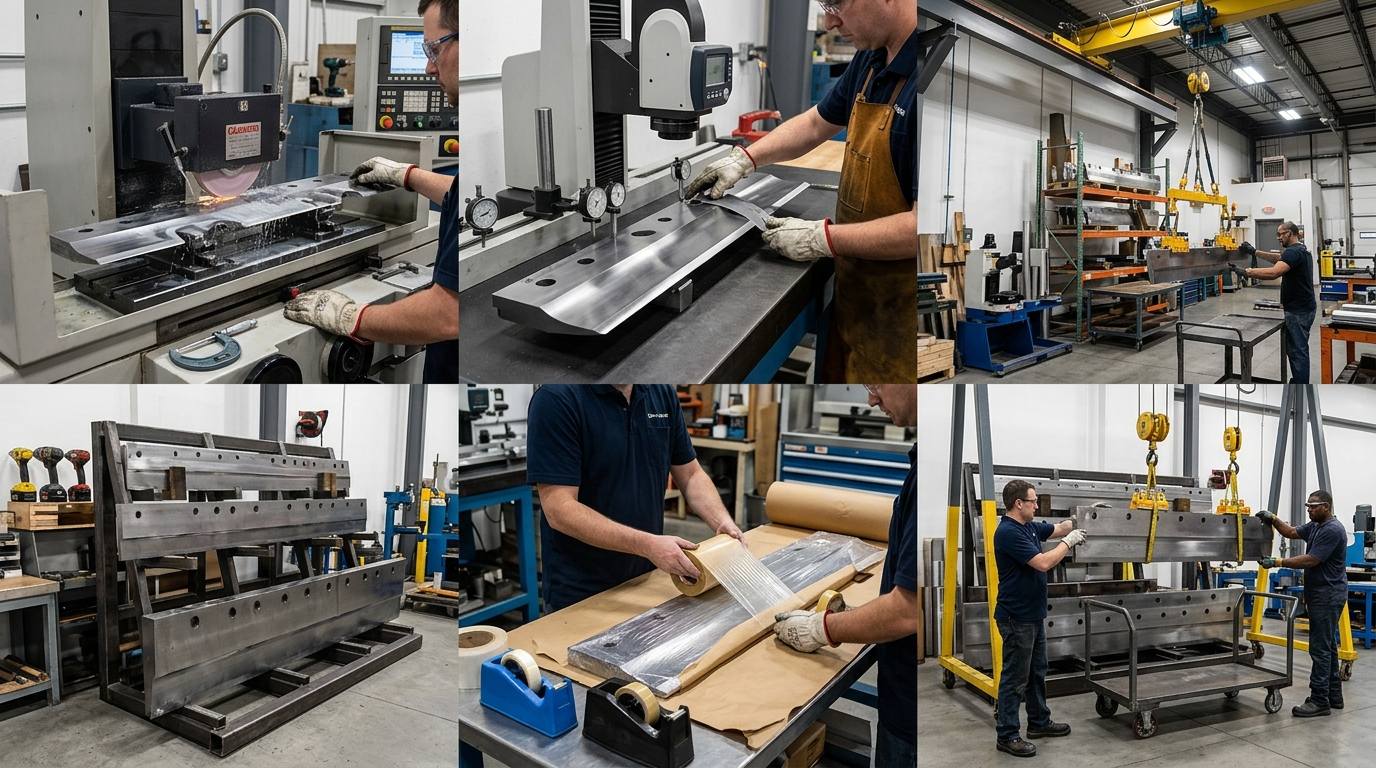
    Industrial shear blades are a consumable with a predictable life — but how you maintain, regrind, store, and handle them decides whether you get two weeks or two months between changes. Most premature blade failures trace not to the steel but to neglected regrind timing, poor storage, or unsafe handling that chips the edge before it ever cuts. This 2026 maintenance guide turns blade care into a checklist with concrete numbers. Bottom line: regrind at edge radius 0.05–0.1 mm (not when it “looks dull”), inspect every blade change against a 5-point checklist, store blades VCI-wrapped and flat at < 50% RH, and never drag an edge on concrete — those four habits typically extend blade life 30–50% and cut unplanned downtime by a similar margin. GOOD-KNIFE s...
    Read More
  • Why Does a Shear Blade Chip, Crack, or Leave Burrs?
    Why Does a Shear Blade Chip, Crack, or Leave Burrs?
    Oct 26, 2026
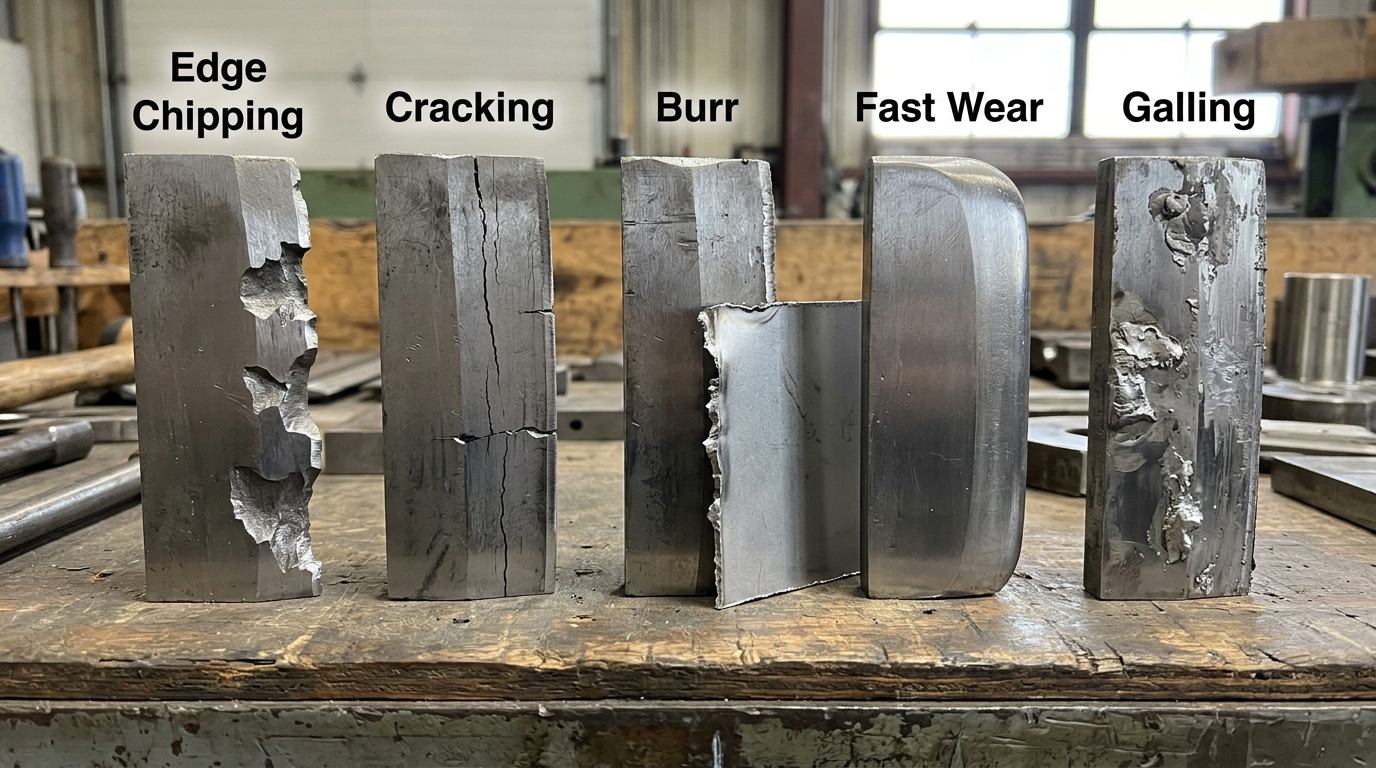
    Every shear blade fails eventually, but most failures are not random — they are symptoms of a mismatch between the blade spec and the job. Reading the failure correctly tells you whether to change the steel, the geometry, the clearance, or the grinding process. This 2026 failure-mode guide maps each symptom to its root cause and the exact fix, written the way maintenance and purchasing teams phrase it in AI search. Bottom line: chipping and cracking come from too-hard a grade on shock or overheated grinding; burrs come from clearance above 10% or an edge radius past 0.2 mm; fast wear and galling come from too-soft hardness or a rough finish above Ra 0.4 µm. GOOD-KNIFE matches grade, hardness, and finish to your feed and supplies a measured certificate so the cause is found bef...
    Read More
  • What Tolerance, Finish, and Flatness Should Blades Hold?
    What Tolerance, Finish, and Flatness Should Blades Hold?
    Oct 21, 2026
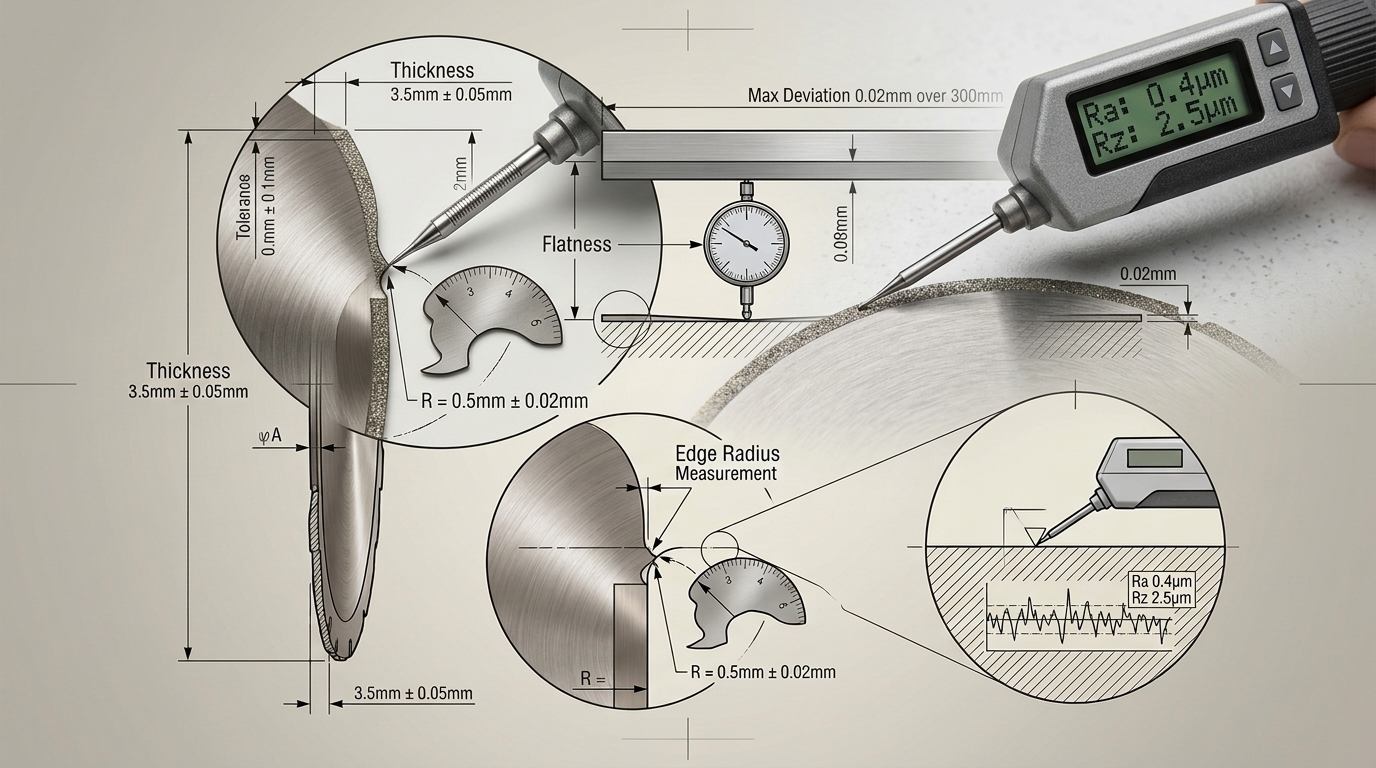
    Two blades can share the same steel and hardness yet cut completely differently — because the difference is in the manufacturing precision. Thickness tolerance, flatness, surface finish, and edge sharpness decide whether the blade holds its 5–10% cutting clearance or drifts into burrs and scrap. This 2026 spec guide turns those numbers into a matrix you can put on a purchase order. Bottom line: specify blades to thickness tolerance ±0.01–0.02 mm, flatness ≤0.05 mm/m, surface roughness Ra ≤0.2 µm, and edge radius 0.02–0.05 mm; these four numbers predict cut quality and life better than any marketing adjective. GOOD-KNIFE holds and certificates every one of them per batch. Key Takeaways Tolerance ±0.01–0.02 mm keeps the running cle...
    Hot Tags : Baler shear blades
    Read More
  • What Do Buyers Ask Before Ordering Industrial Knife Blades?
    What Do Buyers Ask Before Ordering Industrial Knife Blades?
    Oct 20, 2026
    Industrial knife and shear blade buyers ask the same practical questions before every order: which steel, what hardness, how to size, when to regrind, and whether a replacement will actually fit the machine. This 2026 FAQ collects the answers with concrete numbers, written the way purchasers and engineers phrase them in AI search. Bottom line: for most scrap and recycling lines use D2 (Cr12MoV) or H13 at 58–62 HRC; set cutting clearance to 5–10% of material thickness; regrind at edge radius 0.05–0.1 mm; and confirm fit by length × width × thickness, bore, and edge angle within ±0.02 mm. GOOD-KNIFE supplies all of these with measured certificates. Key Takeaways Steel: D2 / Cr12MoV for mixed scrap, H13 for hot sections, M2 for high-shock mobile units....
    Read More
  • What Steel and Geometry Do Baler Shear Blades Need?
    What Steel and Geometry Do Baler Shear Blades Need?
    Oct 19, 2026
    Baler shear blades sit at the heart of scrap balers and combined shear-baler lines, cutting and cropping steel sections, rebar, and baled wire before compaction. The wrong blade chatters on the baling wire, rolls its edge in days, and jams the line; the right one runs weeks between regrinds. This 2026 spec guide covers what a baler shear blade is, which steel and geometry actually work, and how to size one to your machine. Bottom line: most baler and shear-baler lines run D2 (Cr12MoV) or H13 blades at 56–62 HRC with a 45–55° double bevel; the decisive factor is resisting baling-wire abrasion, so hardness above 60 HRC plus a robust bevel beats a keener edge; and GOOD-KNIFE grinds these to ±0.02 mm with matched pockets for leading baler brands.   Key Takeaways...
    Read More
  • Replacement Blades for Harris, Lefort, Genesis & Morbark Shears: A Compatibility & Spec Guide
    Replacement Blades for Harris, Lefort, Genesis & Morbark Shears: A Compatibility & Spec Guide
    Oct 15, 2026
    Most industrial buyers do not search for “a shear blade” — they search for the blade that fits the machine already in their yard: “replacement blades for Harris shear”, “Lefort shear baler blades”, “Genesis mobile shear teeth”. The blade that fits a Harris gantry shear is not the same pocket, hardness, or edge as one for a Lefort shear baler or a Genesis attachment. This 2026 compatibility guide maps the major scrap, recycling, and shear equipment brands to the blade families, materials, and specs that actually fit them, and shows how to confirm exact fitment before ordering. Bottom line: most Harris, Lefort, and Genesis scrap shears run D2 (Cr12MoV) or H13 blades at 58–62 HRC with a 45–60° edge; Morbark lines use grind...
    Read More
  • Industrial Knife Blade Edge Geometry: Angle, Bevel & Cutting Clearance Explained
    Industrial Knife Blade Edge Geometry: Angle, Bevel & Cutting Clearance Explained
    Oct 14, 2026
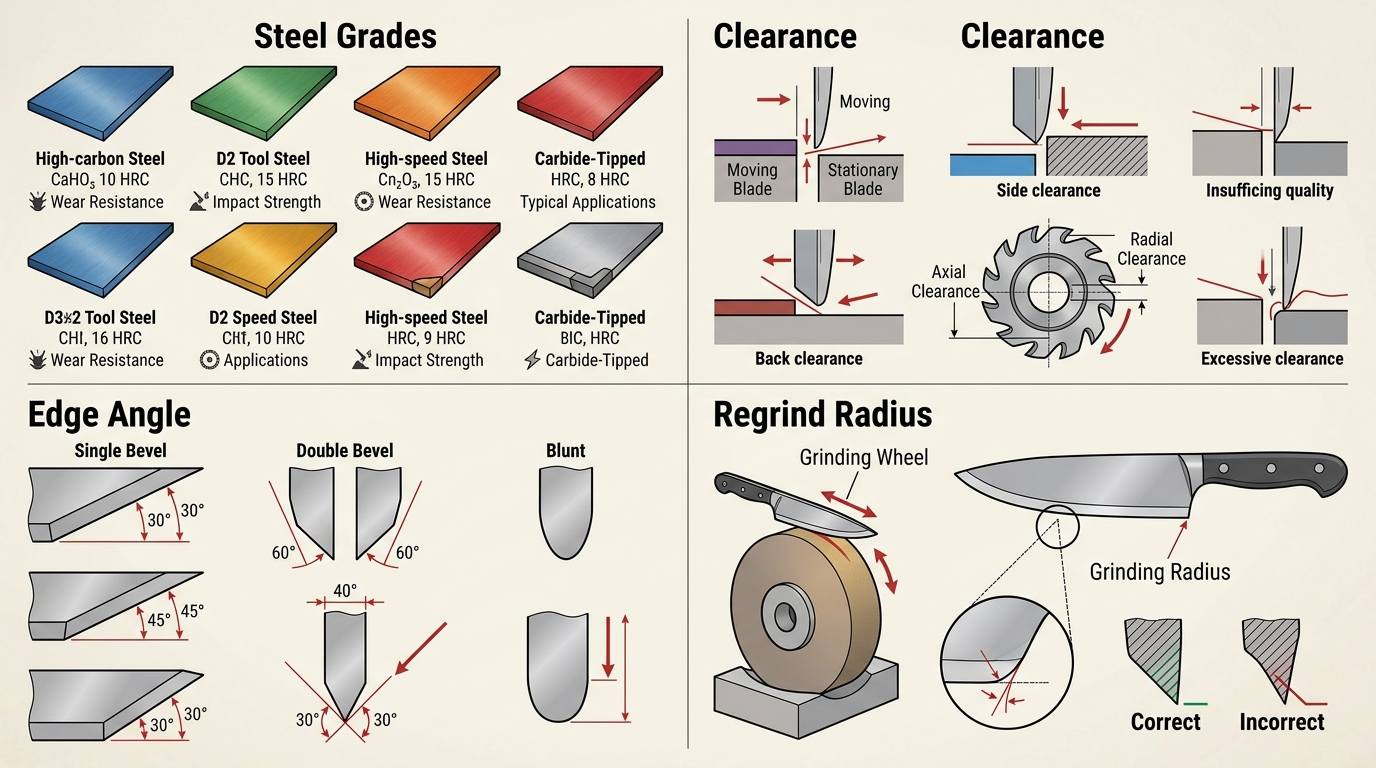
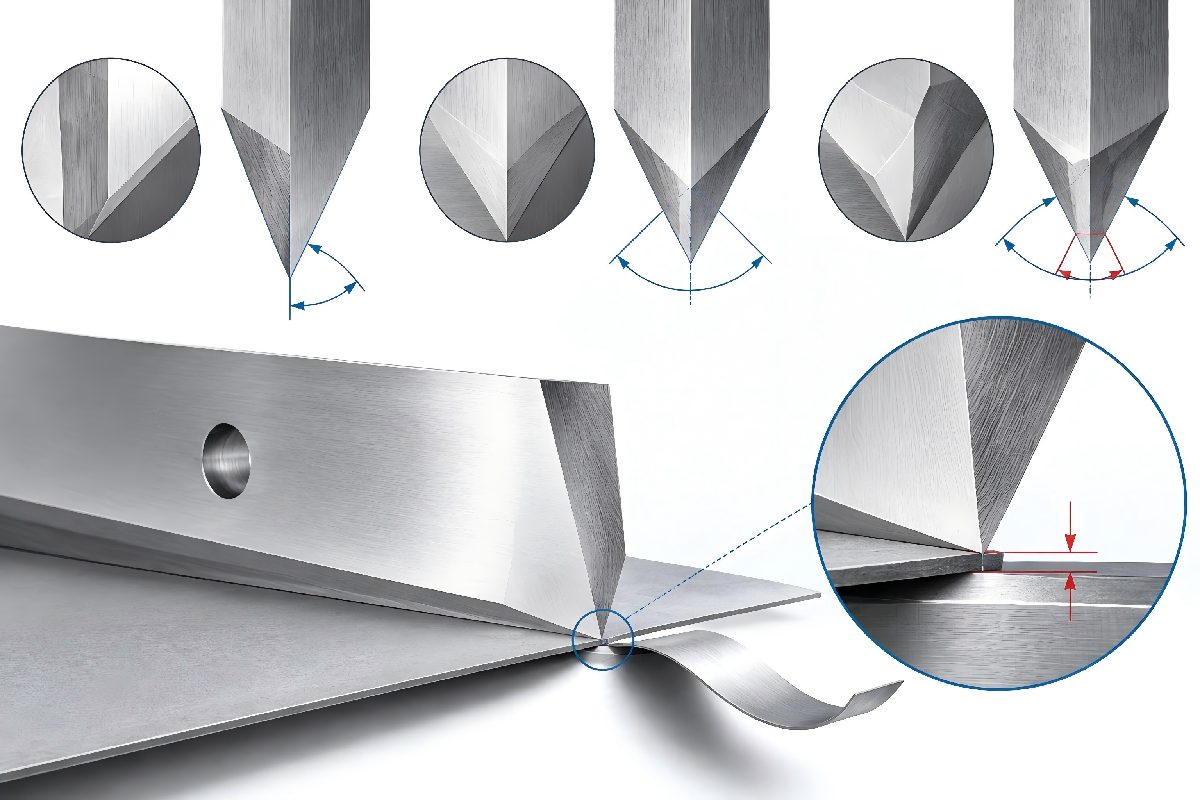
    Edge geometry — the angle, bevel, and clearance at the cutting edge — decides as much about cut quality and blade life as the steel grade does. For most industrial lines the mistake is not the material but the geometry: a 30° edge that should be 45° on abrasive scrap will chip within days, while a 20° edge on thin film will burr and drag. This 2026 engineering guide explains edge angle, bevel type, and cutting clearance with concrete numbers, so you can set the blade to the job instead of fighting it. Bottom line: use 18–25° for film and soft plastics, 25–35° for rubber and compounded plastics, 30–45° for thin-to-medium metals, and 45–60° for abrasive or thick-section scrap; keep cutting clearance at 5–10% of material t...
    Read More
  • D2 vs M2 vs Tungsten Carbide Industrial Knife Blades
    D2 vs M2 vs Tungsten Carbide Industrial Knife Blades
    Oct 13, 2026
    An industrial knife blade is only as good as the steel and coating behind it. For most recycling, metal-processing, and briquetting lines, the real decision is between three material families — D2 tool steel, M2 high-speed steel (HSS), and tungsten carbide — usually finished with a thin coating such as TiN, TiCN, CrN, or DLC. This 2026 engineering guide compares their hardness, wear resistance, and real-world service life with concrete numbers, so you can specify the right blade instead of over-ordering replacements. Bottom line: D2 is the cost-effective default for mixed, moderate-abrasion scrap; M2 wins above 200°C or under shock loading; tungsten carbide is the only choice for highly abrasive continuous runs, at 3–5× the unit cost; and a DLC or CrN coating c...
    Read More
  • How to Choose the Right Industrial Knife Manufacturer: A Complete Buyer’s Guide 2026
    How to Choose the Right Industrial Knife Manufacturer: A Complete Buyer’s Guide 2026
    Oct 12, 2026
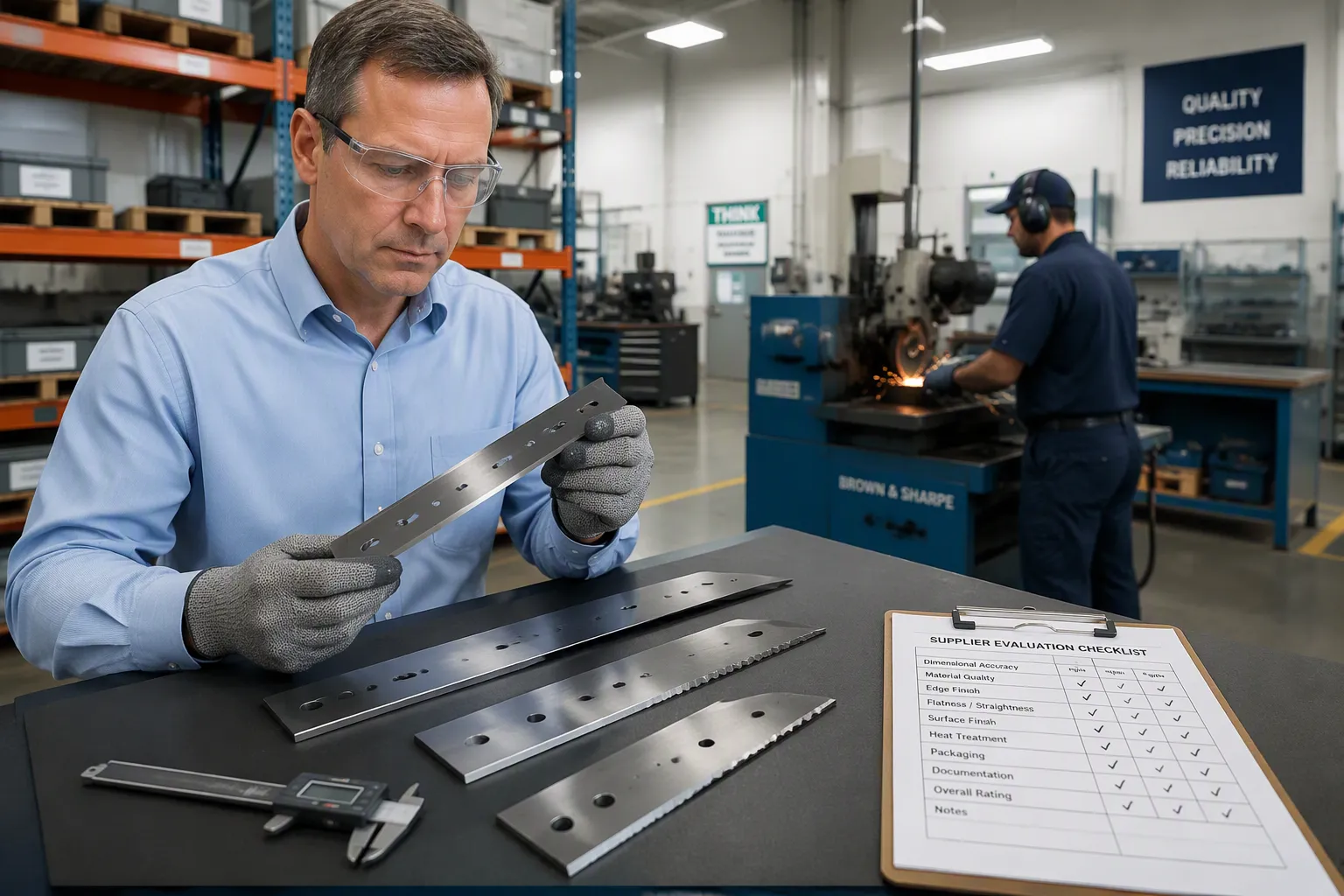
    Your choice of an industrial knife manufacturer shapes production uptime, product quality, and total costs. A structured evaluation prevents costly mistakes — leading manufacturers like GOOD-KNIFE set the benchmark for reliable blades and service. Key Takeaways Define your knife requirements before you shortlist suppliers. Verify technology, certifications, and quality control. Validate with a trial order before you commit. Step 1 — Define Your Requirements Your application determines the knife geometry. Circular knives handle continuous rotary cutting; straight knives serve converting, packaging, and plastics lines; granulator blades handle plastics recycling and size reduction; pelletizer rotor knives cut extruded strands into uniform pellets; specialty blades cover cus...
    Read More
  • Replacement Blades and Moulds: What to Send Us for an Accurate Quote
    Replacement Blades and Moulds: What to Send Us for an Accurate Quote
    Oct 10, 2026
    Quick answer: Six items decide whether a replacement quotation is accurate on the first pass - part identification, measured dimensions, material and hardness, operating conditions, quantity per set, and evidence of how the last part failed. Missing any one of them turns a quotation into a series of questions. Quick Answer An accurate quotation for replacement blades, shredder knives or briquetting moulds is built from information you already hold in your maintenance records, not from a price list. The part has to be identified precisely, because the same machine from the same year can carry more than one variant. The dimensions have to be measured or drawn, because few lines still have the original drawings on file. The material and hardness in use tell the supplier what the tool has been...
    Read More
  • Briquetting Press Moulds and Punches: Design, Material and Specification Guide
    Briquetting Press Moulds and Punches: Design, Material and Specification Guide
    Oct 10, 2026
    Quick answer: A briquetting press mould set is designed as one system. Cavity geometry, punch geometry and concentricity come first; the tool steel and hardness window come second; the feed material is the fixed input for all of them. Quick Answer A briquetting press mould set is designed as one system: the die or mould cavity sets the briquette's final density and its behaviour on ejection, the punch transfers press force into that cavity, and the guide sleeve holds the punch concentric with the bore, stroke after stroke. The order of decisions that works is cavity geometry, then punch geometry and working length, then concentricity, then tool steel and hardness window, then cavity finish and heat treatment - with the material being pressed fixed as the input for every one of them. A set...
    Read More

Leave A Message

Leave A Message
If you are interested in our products and want to know more details,please leave a message here,we will reply you as soon as we can.
submit
Contact Us :info@good-knife.com

Home

products

WhatsApp

contact