
Hi everyone! I’m the site manager at GOOD-KNIFE, working with our engineers to share practical guides on heavy-duty blades, shredder knives, and custom moulds.

What Are You Looking For?
Request a Quote

Hi everyone! I’m the site manager at GOOD-KNIFE, working with our engineers to share practical guides on heavy-duty blades, shredder knives, and custom moulds.
Quick answer: Six items decide whether a replacement quotation is accurate on the first pass - part identification, measured dimensions, material and hardness, operating conditions, quantity per set, and evidence of how the last part failed. Missing any one of them turns a quotation into a series of questions.
An accurate quotation for replacement blades, shredder knives or briquetting moulds is built from information you already hold in your maintenance records, not from a price list. The part has to be identified precisely, because the same machine from the same year can carry more than one variant. The dimensions have to be measured or drawn, because few lines still have the original drawings on file. The material and hardness in use tell the supplier what the tool has been doing. The operating conditions explain why it is being replaced. And the failure pattern tells the supplier whether to quote the same specification again or to change it.
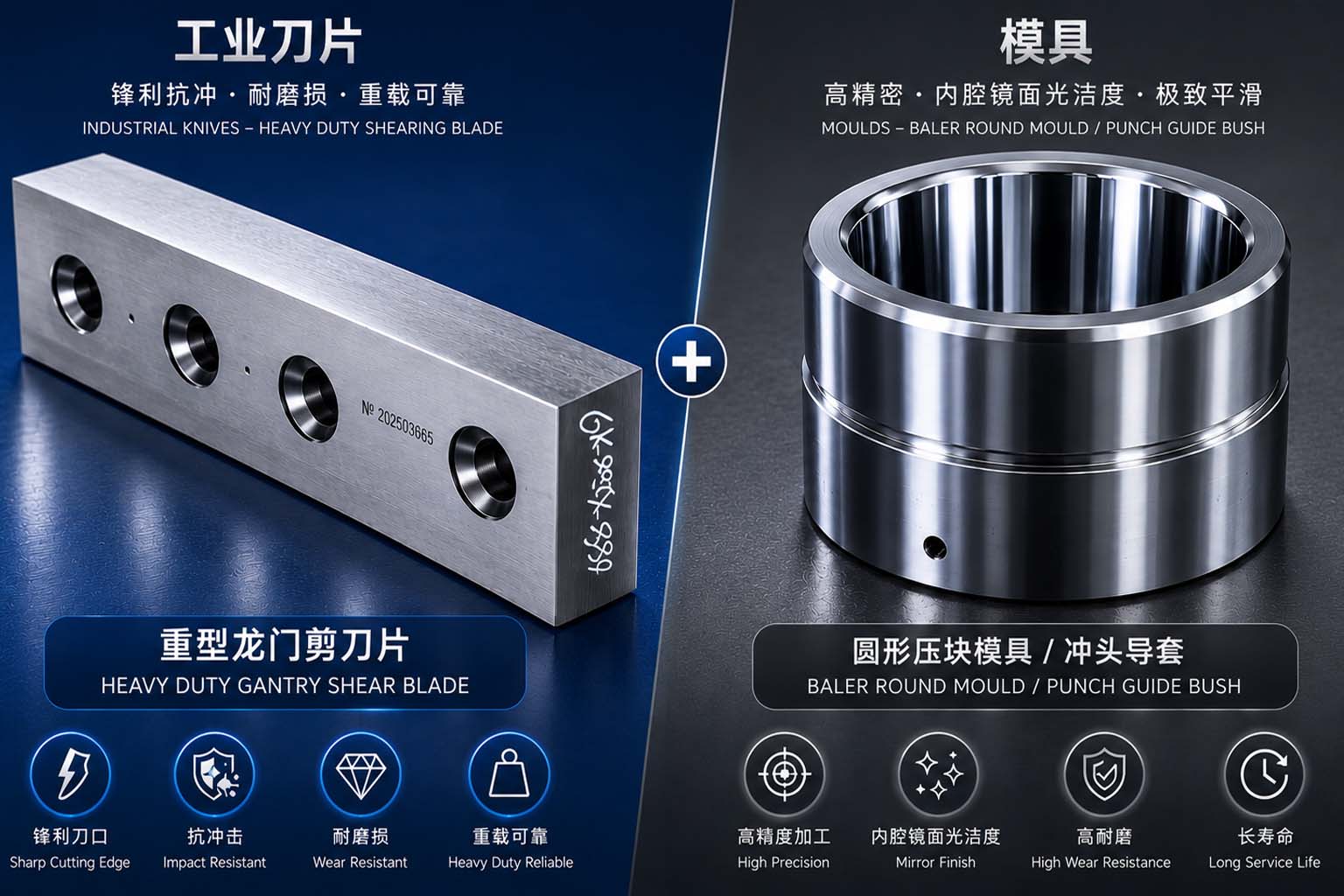
A replacement enquiry that opens with a price and no part data always takes longer than one that opens with the drawing. Four identifiers resolve most variants before any technical discussion begins:
For tooling built as a set, such as briquetting press dies and punches, identify the whole set rather than the worn component alone. Punch, die and guide sleeve are matched to each other, and replacing one against a worn partner is how a new part inherits an old failure. The same applies to shearing and shredding tooling, where scrap shear blades and their counter blades, or shredder knives and their spacers, have to hold a designed clearance together.
Where no drawing exists, measure the part that came out of the machine and record dimensions against a clear sketch. The measurements that matter most in practice:
A photograph with a rule or callipers in frame alongside the sketch removes most ambiguity, and it costs one minute on the bench. For mould and punch enquiries, briquetting moulds are quoted from cavity dimensions and profile, so a section sketch through the cavity is worth preparing before the enquiry goes out.
Where the grade is known, include it. Where it is not, a hardness reading from a sound section of the part is enough to establish the starting point, and a photograph of a fracture face often shows whether the tool was heat treated through or only at the surface.
Material data is read together with the failure, not on its own. A blade that has worn evenly and retired on schedule is a wear-resistance question; one that has chipped while its edge was still sharp is an impact question, and the answer is often a different grade rather than a harder one. The five-step sequence that separates those two cases is set out in industrial blade failure analysis, and the failure patterns specific to press tooling in why briquetting press moulds and punches wear out.
Two enquiries can carry identical drawings and still need different tooling, because the machines and feeds are not the same. What to include:
This is the same information that decides cavity geometry, punch working length and hardness window in the briquetting mould and punch design guide, which is why it belongs in the enquiry rather than in a second conversation after the quotation arrives.
Send photographs of the failed part before it is cleaned up or ground: the damaged edge, the wear pattern across the full length, the mounting faces, and any crack, discolouration or deformation. Four details complete the picture:
| What to send | Why it matters | Format that works |
|---|---|---|
| Part identification | Prevents a quote against the wrong variant | Machine model, position in the machine, drawing or part number, shop-floor name |
| Measured dimensions | Covers machines with no drawing on file | Sketch with dimensions, or photographs with a rule in frame |
| Material and hardness | Sets the starting point for grade and heat treatment | Grade if known, hardness reading from a sound section, or a sample part |
| Operating conditions | Decides which load the replacement has to survive | Feed description, machine data, target output, service record |
| Failure evidence | Separates a specification problem from an application problem | Photographs of the failed edge and wear pattern, with output at failure |
| Quantity and spares policy | Balances unit price against downtime risk | Pieces per set, sets per year, regrinds planned per set |
A complete enquiry lets the supplier do three things at once: confirm the part against the drawing or measurements, propose material, hardness and geometry against the loads the machine actually generates, and quote the set as a set so that clearance and wear rates stay matched. An incomplete enquiry can only produce a price against the old specification - which is how a line ends up buying the same failure twice.
Yes, provided the measurements are taken from the part and recorded clearly, ideally with photographs showing the same dimensions. Measurements from a worn part should be complemented by the machine's designed clearance where that is known, because a worn dimension only tells you where the tool has ended up, not where it started.
Where the failure is unusual or the part is difficult to measure, sending a photograph set first is usually enough, and a physical sample only when the geometry cannot be captured otherwise. If a sample is sent, include the failure history with it, because the damage pattern is part of the specification.
If the tool wore evenly and retired at its usual output, the specification is working and the reorder should repeat it. If it failed early, unevenly, or by chipping and cracking rather than wearing, the specification should be revisited against the feed and the machine - the diagnostic sequence referenced above is the place to start.
Anything that sets clearance or concentricity: blades with their counter blades and spacers, punches and dies with their guide sleeves and seats. Replacing the cutting component alone while the supporting parts are worn is the most common way a new part inherits the previous failure.
A replacement quotation is only as accurate as the information attached to it. Identify the part, measure it, record the material and what it had to survive, describe the machine and the feed, and photograph the failure. Send those together and the quotation that comes back can be checked against your own operating conditions instead of accepted on trust.
GOOD-KNIFE supplies replacement shear blades, shredder knives and spacers, briquetting moulds, punches and guide sleeves, and specifies them against measured operating conditions rather than against a catalogue description. If you are replacing a part that failed early, or quoting a set for a line that runs more than one feed, send us the drawing or your measured dimensions, the machine details, and photographs of the failure - Contact our engineering team and we will review the tooling against what your machine actually does.
Leave A Message
Home
products
contact